


Improving communication skills in the workplace is not about teaching people to be better talkers. It is about building a shared set of habits, listening practices, and feedback norms that a team actually uses, every day, without being reminded. That starts with leadership. When a leader models the standard, the team picks it up. When a leader ignores it, the team falls back on whatever habits already exist, and those are usually the habits causing the friction in the first place.
That distinction gets skipped in most communication advice. Teams rarely struggle because people lack knowledge. They struggle because nobody ever agreed on a standard, and standards are set from the top down, not the bottom up. This is the gap we spend most of our time closing with leadership teams: not a personality problem, a missing operating standard.
What Workplace Communication Skills Actually Are
Workplace communication skills are the behaviors a team relies on to exchange information, give and take feedback, and reach decisions without losing time to confusion. That means how people listen in meetings, how clearly they state what they need, how they handle disagreement, and whether they actually follow up on what was agreed.
It has nothing to do with charisma or being naturally talkative. Some of the sharpest communicators we've trained are quiet and economical with their words. What sets them apart is precision, not personality.
We see the same pattern across the leadership teams and managers we work with: it is rarely a shortage of good ideas. It's that the ideas never make it cleanly from one person to the next. Closing that gap is the entire premise of our Communication Skills Training programs.
Why This Is a Business Problem, Not a Soft Skill

Communication breakdowns rarely get labeled correctly. They show up as missed deadlines, meetings that should have been a single message, decisions that get remade because nobody was clear the first time, and good people who quietly check out because they stopped feeling heard.
Misalignment, cross-functional friction, collaboration that stalls: nine times out of ten, that's a communication gap wearing a different costume. It's not a skills gap and it's rarely a motivation problem. Leaders tend to chase the symptom, the missed deadline, the stalled project, without ever fixing the root cause, which is that the team never had a real standard to work from.
We're intentionally careful here about throwing out precise statistics on what poor communication costs a business. Most of the numbers that circulate in this space can't be traced back to anything credible. What we can tell you, from sitting inside these organizations, is simpler and more useful: teams with a clear communication standard move faster and redo less work than teams without one.
A Practical Framework for Building Workplace Communication Skills
Fixing this at the team level is a practice, not a single workshop. Here is the framework we actually use:
1. Establish a listening standard.
Almost everyone believes they're a good listener. Far fewer actually are. Try this after your next meeting: can each person accurately repeat back what the other side needed, not just what was said? If not, your team is talking past each other, not to each other.
2. Separate real-time conversations from written updates.
Not everything needs a meeting. Give the team a clear rule: anything complex, sensitive, or relationship-dependent happens live. Anything routine or informational goes in writing. That one distinction cuts a surprising amount of meeting fatigue on its own.
3. Make expectations explicit, not implied.
Vague instructions turn into guesswork, and guesswork turns into rework. When you close out a task or a meeting, say the next action, the owner, and the timeline out loud. Don't assume it's obvious, because it usually isn't to the person on the other end. This connects directly to speaking clearly and concisely in the workplace: unclear instructions are almost always a symptom of unclear thinking, not a lack of effort.
4. Build a feedback loop that survives disagreement.
Strong communicators don't avoid conflict, they have a process for it: name the issue, stay on the specific problem instead of the person, and agree on one concrete next step. If this is where your team gets stuck, a communication coach can help you practice the hard conversation before it happens for real.
5. Leaders model the standard first.
Most frameworks quietly skip this step. A standard only sticks when leadership visibly follows it themselves, including in the uncomfortable moments, like admitting a decision was unclear or walking back an instruction that was rushed.
This is the same discipline built into the Moxie Model©, the methodology behind every training and coaching engagement we run. It's designed to be practiced, not just read. Teams apply each step in real working scenarios instead of hearing it once in a lecture, because communication habits change through repetition, not through information.
If any part of this sounds like your team, it's worth a conversation before it hardens into a pattern. That's exactly what our Communication Skills Training programs are built for.
Where Leadership Communication and Team Communication Intersect
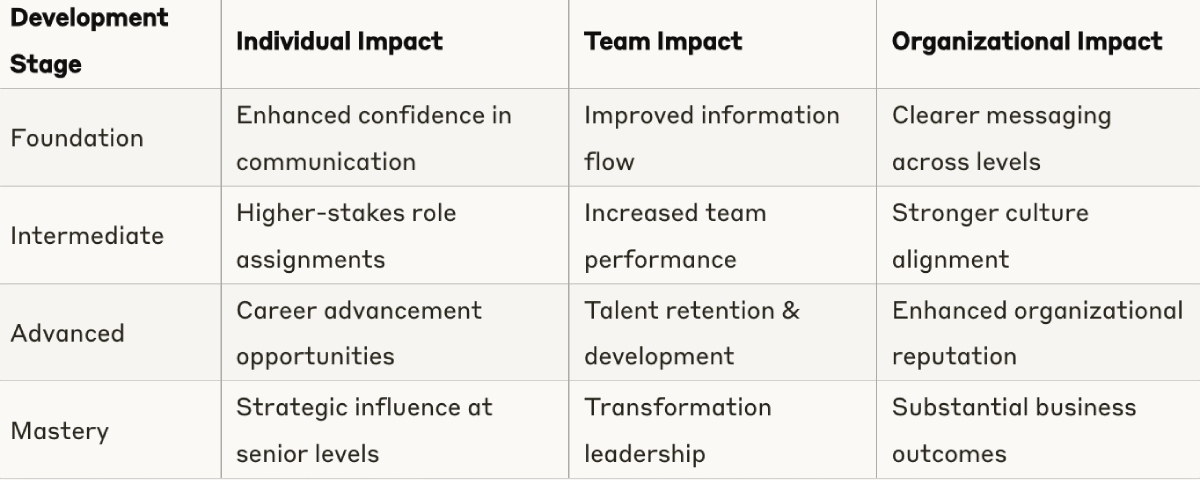
Workplace communication doesn't exist separately from leadership. A team's communication ceiling is almost always set by its leader's habits. A leader who's vague, reactive, or inconsistent under pressure will see that same pattern reflected back by the team, no matter how many communication tips get circulated.
That's why we treat this as a leadership-driven capability, not a checklist for individual contributors. Leaders who want better communication from their teams usually need to build it in themselves first, especially under pressure and in the moments where credibility is actually on the line. If that's the real gap, executive presence training goes directly at the leadership behaviors that determine whether someone is heard, trusted, and followed.
For leaders dealing with higher-stakes executive communication specifically, board meetings, crisis messaging, and the like, how to improve communication skills for executives covers that ground in more depth.
Common Mistakes That Undermine Workplace Communication
Treating communication as an event instead of a practice. One workshop won't undo habits that took years to form. Real change comes from repeated practice and feedback, not a single session on the calendar.
Assuming clarity instead of confirming it. Most leaders believe they were clear because the message made sense to them. The only test that actually matters is whether the listener can repeat back what was asked of them.
Rewarding the loudest voice instead of the clearest one. Confidence gets mistaken for clarity more often than it should. The person who speaks first and most often doesn't always have the best information, and when volume gets treated as a proxy for value, your team quietly learns to stop offering its best thinking.
Skipping the follow-up that confirms the message actually landed. Most leaders consider a message delivered the moment it's been said out loud. It's only actually delivered once the listener can act on it correctly, and that requires a follow-up check that most people skip entirely.
Frequently Asked Questions
What are the most important communication skills for the workplace?
Active listening, being explicit about expectations instead of implying them, and having an actual process for disagreement. Those three account for most of the friction we see when they're missing.
Can communication skills actually be trained, or are some people just naturally better at it?
They can be trained, full stop. Communication is a behavioral skill built through practice and feedback, not something you're born with. The people who seem naturally gifted at it have usually just practiced it longer, or more deliberately, than everyone else.
How long does it take to see improvement in team communication?
Individual habits can shift in a few weeks with deliberate practice. Culture change, where the new norms become the default instead of the exception, takes longer, and it sticks fastest when leadership visibly reinforces it rather than just announcing it.
Is workplace communication training different from public speaking or presentation training?
Yes. Presentation skills are about one-to-many delivery in a single defined moment. Workplace communication is the ongoing, daily exchange between colleagues: meetings, feedback, written updates, the stuff that happens constantly, not occasionally.
Where should a leader start if their team's communication feels broken?
Start with listening, not talking. Most leaders diagnose this backward, assuming the fix is a clearer message from them, when the real gap is that nobody on either side is confirming understanding.
Where to Go From Here
Communication isn't the soft skill it keeps getting filed under. It's the operating system your team runs on, and like any operating system, it has to be built on purpose instead of left to chance.
If your team is living any part of what's described here, misalignment, rework, unclear ownership, that's usually a sign the organization has outgrown its current communication habits and needs something more structured.
Book a complimentary strategy session to talk through what's actually driving the breakdown on your team, and whether Communication Skills Training is the right next step.