



The leader who gets passed over is rarely the least capable person in the room. More often, it is the one whose capabilities simply do not register with the people making the decision. Strong ideas. A solid track record. And still, something is not landing in the conversations that count. Colleagues trust them in execution. Senior stakeholders stay unconvinced.
That gap has a name. And closing it is what executive presence development is actually about.
What Is Executive Presence?

Executive presence is the ability to project confidence, clarity, and credibility in high-stakes leadership moments so that others trust your judgment, follow your direction, and want to work with and for you. It is what makes a leader's expertise feel authoritative rather than merely competent, and it determines how much organizational influence a leader earns beyond the boundaries of their formal title.
Moxie's resource on what is executive presence covers the full landscape: how it is defined, what it looks like in practice, and how it develops across career stages. Worth reading if you are starting from the beginning.
Here is what matters most for this conversation: executive presence is not a personality trait. Not charisma. Not something you are born with while others simply are not. It is a specific set of communication behaviors, emotional regulation skills, and influence habits that can be taught, practiced, and measurably improved. That is precisely why executive presence training produces results that self-study and accumulated experience alone rarely do.
Five reasons it matters, across every career stage.
Reason 1: Expertise Without Presence Does Not Travel Far
Almost every organization has this person: the technically excellent leader whose ideas consistently fail to get the traction they deserve.
They present in a leadership meeting and the room moves on. A solid recommendation goes unheeded, then gains momentum weeks later when someone with more visible authority raises the same idea. Feedback arrives about unclear communication or the need to work on "executive readiness," with no real explanation of what that means in practice.
This is the expertise-influence gap. Not a capability problem. A presence problem. And it is more common, and more costly, than most organizations want to acknowledge.
Presence is the mechanism that carries expertise across the room. Without it, knowledge stays local, influence stays limited, and genuinely good ideas fail to generate the alignment and action they deserve. The leaders who move organizations are not always the ones who know the most. They are the ones who make others feel certain that acting on what they know is the right call.
For organizations: High-potential leaders who have hit a performance ceiling are often not missing knowledge. They are missing the presence skills that make their knowledge land credibly with the audiences who need to act on it. That gap responds well to structured training. It rarely resolves on its own.
Reason 2: It Is a Significant Factor in Senior Leadership Advancement

Research from the Center for Talent Innovation into what actually drives senior promotion decisions is worth sitting with. Executive presence consistently emerges as a meaningful contributor to advancement, alongside performance and strategic fit, and its influence is strongest precisely when candidates are technically comparable. At that point, the real question becomes not who is most qualified, but who feels ready to lead at the next level.
That word, "ready," deserves unpacking. When a leader hears they are not quite ready despite a strong track record, the feedback is almost never about performance. It is about presence. How they handle pressure in a senior room. Whether their communication carries authority when challenged. Whether the people above them leave a meeting feeling confident or still uncertain. These are behavioral patterns. Every one of them is trainable.
For organizations, the implication is direct: if presence contributes to advancement decisions and it can be developed, then building it systematically in your high-potential pipeline is a more efficient use of existing talent than waiting for it to surface on its own. The leaders who advance fastest are rarely the ones who waited for the right moment to start. They built it before they needed it most.
For leaders: If your performance is strong and advancement is still stalling, find out honestly whether the barrier is presence-related. When feedback includes words like "clarity," "executive readiness," or "owning the room," that is the signal. A focused investment in those specific behaviors will move the needle faster than another year of compounding technical expertise.
Ready to explore what executive presence development looks like for you or your team?
A complimentary strategy session with Moxie is a practical first step. Book your session here.
Reason 3: Presence Under Pressure Is Where Leadership Credibility Is Actually Built
Any leader can appear capable when things are going well. The real evaluation comes when they are not: a board question that catches them off guard, a high-stakes negotiation where the other side is pushing hard, a change announcement to a team that is not ready to hear it, a media appearance where every word is being weighed.
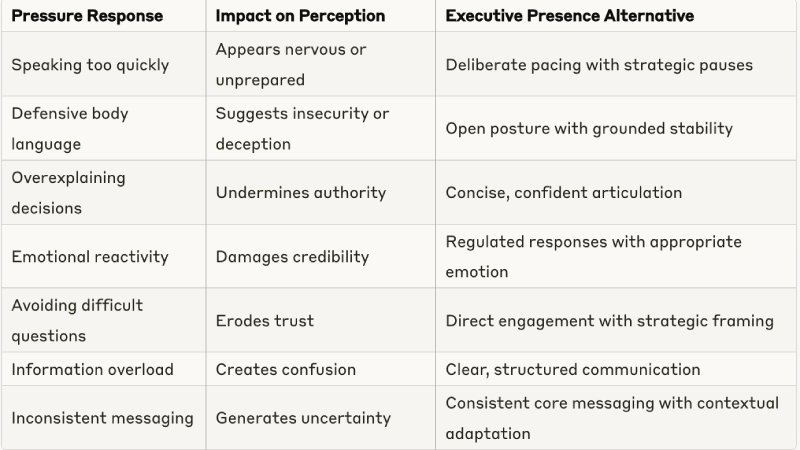
Leaders who have built executive presence handle those moments differently. Under pressure, they stay clear and grounded. Vocal authority holds rather than wavering. Nothing in their body language signals to the room that things are slipping. They can sit with a hard question without rushing to fill the silence with defensive hedging, and they can acknowledge uncertainty without forfeiting anyone's confidence in the process.
That is composure as a trained behavior, not a personality trait. What we see consistently in Moxie's coaching and training work with leaders across industries is that performing under pressure is one of the most developable dimensions of executive presence, and one of the most underinvested areas in standard leadership programs. Most programs concentrate on strategic thinking and analytical rigor. Very few actually put leaders into high-pressure communication conditions with real-time feedback, where the behavioral habits that matter most under fire are actually built.
Building executive communication skills that hold under pressure requires practicing in conditions that approximate real stakes closely enough for the skills to transfer. Reading about composure does not produce it. Being coached through the moments where your responses break down does.
For organizations: Leaders who consistently lose authority in Q&A, difficult stakeholder conversations, or high-stakes announcements are coachable. The gap is behavioral. Organizations that address it proactively outperform those waiting for a visible failure to make the investment feel obvious.
Reason 4: It Shapes Team Performance, Not Just Individual Perception
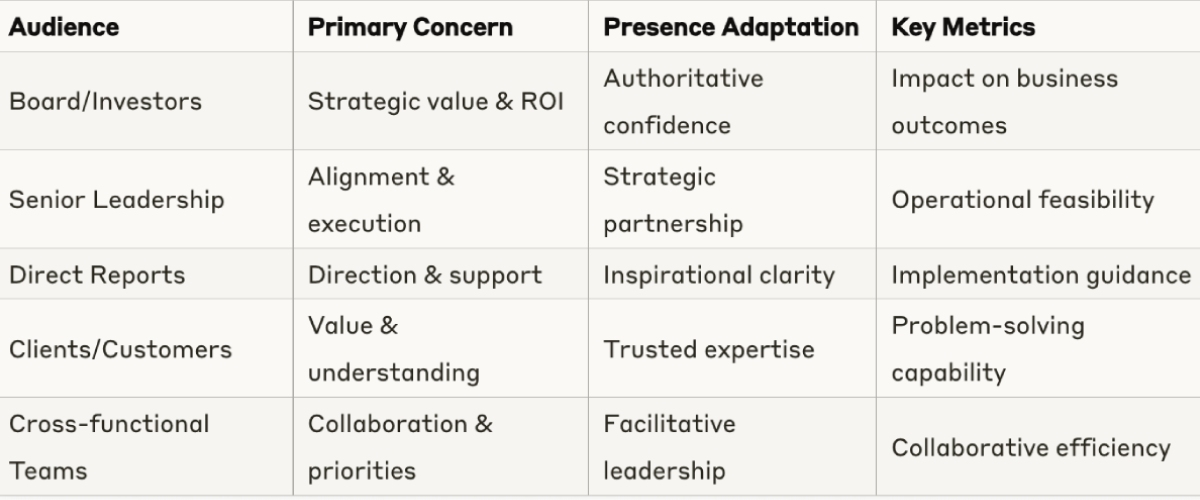
Executive presence is usually discussed as a personal career asset. That framing substantially undersells what is actually at stake.
A leader's communication quality flows directly into how their team operates day to day. When a leader speaks with clarity and conviction, their team has sharper direction, less ambient anxiety, and stronger alignment around what actually matters. When that presence is inconsistent or weak in senior rooms, the cost does not stay contained. It travels downstream, and teams end up spending energy managing the uncertainty their leader's communication creates rather than executing.
Research from organizational behavior bodies including Gallup has consistently found meaningful associations between leadership communication quality and team engagement and performance outcomes. The precise magnitude varies by study and context, but the directional finding holds: how leaders communicate is not a soft input. It shapes hard outputs.
There is a compounding visibility effect, too. A leader who can represent their team's work effectively in senior rooms opens doors that would otherwise stay closed. They advocate credibly. They surface the work and secure the resources it needs. They convert execution into organizational impact. A leader who cannot do this, regardless of how strong the underlying work is, limits what their team can achieve beyond their immediate sphere.
For organizations: Executive presence investment is team performance investment. The ROI calculation shifts substantially when you account for the downstream effects on every team those leaders touch.
Building the business case for executive presence training in your organization?
A strategy session with Moxie can help you structure the argument and identify where to start. Book your session here.
Reason 5: Earlier Development Pays More Than Later Remediation
The most persistent myth about executive presence is that it develops naturally over a long career: that leaders who need it will eventually grow into it, and that coaching only becomes relevant after something has gone wrong.
Coaching practice tells a different story.
Executive presence is trainable at every career stage. Communication clarity, composure under challenge, audience reading, the ability to structure a message that moves people toward a decision: all of these improve with deliberate practice and quality feedback. What changes as careers advance is not trainability. It is the margin for error.
A senior manager with a developing presence gap still has room to work with. Slower advancement and reduced cross-functional influence are real costs, but they are recoverable. A senior executive with the same gap is operating in a completely different situation. High-stakes visibility moments arrive more often and with less warning. A poor performance at board level, in front of investors, or during a major change announcement carries substantially higher organizational cost. Recovery is harder. The window for development narrows because the pressure simply does not relent.
The organizations that see the strongest return from executive presence investment build it in high-potential leaders before expanded visibility arrives, not in the wake of a specific failure. Developing strong executive presentation skills and the broader presence competencies that support them before a leader needs them at the highest level is consistently more effective than emergency coaching once the gap has become both costly and public.
For organizations: Look at your leadership pipeline with presence in mind. Where are your high-potentials in their development arc? The answer to that question tells you whether your investment timing is right.
The Presence Gap Diagnostic: A Moxie Framework

In working with leaders across industries and organizational levels, what we have learned is that presence gaps do not all look alike. A leader who collapses under hostile Q&A has a different problem than one whose ideas never seem to build momentum, even when both get the same vague feedback about needing "more executive presence."
Accurate diagnosis is what makes development efficient. Generic training produces generic outcomes. The leaders who close their gaps fastest are the ones whose development targets where they are actually stuck.
Most presence gaps fall into one of three categories:
The Clarity Gap
Smart in the room. The people in the room leave unsure what to do about it. This is a communication architecture problem: how information gets sequenced, what gets simplified, and what lands versus what drifts past. Leaders with this gap are often described as hard to follow despite being clearly knowledgeable, or as strong analysts who have not yet learned to communicate at the executive level. Development focuses on recommendation-first message construction and the discipline of translating depth into usable clarity without losing the substance that earned them the room.
The Composure Gap
Solid in low-stakes situations. Under pressure, when challenged or when the room turns skeptical, authority visibly erodes. The voice shifts. The body signals discomfort. Answers become over-qualified or defensive in ways that undermine what the leader actually knows. This is a behavioral regulation problem, not a knowledge gap. Development focuses on coached practice under genuine pressure: challenging Q&A formats, difficult stakeholder simulations, and high-stakes rehearsals with specific, real-time feedback calibrated to how the leader actually breaks down.
The Conviction Gap
The content is clear. The delivery is technically competent. And somehow the presentation still does not move anyone. No energy. No forward pull. No sense that the audience needs to act on what they just heard. This is an influence architecture problem. Development focuses on strategic storytelling, the deliberate use of emphasis and pacing, and learning to communicate with a genuine point of view rather than from behind a carefully neutral presentation surface.
Most leaders have a dominant gap, with traces of the others present. A strong program begins with diagnosis and concentrates development where the return will be highest.
What Executive Presence Is Not
Because misconceptions drive how organizations invest, it is worth being direct.
It is not charisma. Charisma is a magnetic personal quality that tracks closely with personality type and is difficult to develop through training. Executive presence is a skill set, and it is available to every leader regardless of natural style. Introverted leaders develop it. Analytically oriented leaders develop it. Reserved leaders develop it. The path looks different, but the destination is the same: credibility, clarity, and authority in the rooms that matter most.
It is not appearance management. The image-consulting version of executive presence advice concentrates on clothing, grooming, and physical presentation. That addresses the smallest and least impactful dimension of how leaders are perceived when something real is at stake. Most organizations significantly over-invest here and under-invest in the communication behaviors and emotional regulation skills that actually build and sustain trust.
It is not a fixed trait. The leaders who appear most naturally authoritative have almost always had access to coaching, spent time in high-visibility roles that forced rapid development, or deliberately studied and practiced the communication behaviors that create authority. What looks innate is almost always accumulated.
Building Executive Presence: A Practical Path
Good intentions do not build presence. Neither does self-awareness without structured practice. Here is what development that actually produces lasting change looks like:
Step 1: Diagnose the gap. Use the Presence Gap Diagnostic above to identify whether the primary issue is clarity, composure, or conviction. Unfocused development produces unfocused results.
Step 2: Practice in conditions that create real pressure. The environment needs to approximate actual stakes closely enough for the skills to transfer. Rehearsing a high-stakes presentation in a low-stakes room builds some things. Coached conditions that introduce genuine pressure, interruptions, challenging questions, unfamiliar audiences, build the habits that actually hold under fire. Moxie's experiential training methodology is built specifically for this work.
Step 3: Get feedback from someone who has seen the real thing. Self-perception in high-stakes communication situations is notoriously unreliable. Leaders routinely misread their own performance in both directions. A coach who observes real communication behavior and gives specific, actionable feedback accelerates development in ways peer feedback and self-reflection alone cannot.
Step 4: Apply deliberately in live moments. Take one specific behavior from each coaching or training session and carry it into the next real meeting, presentation, or stakeholder conversation. Skills confined to the training room fade quickly.
Step 5: Keep developing as visibility increases. The demands on presence grow as leadership scope grows. Leaders who sustain development over time through executive coaching consistently outperform those who treat presence as a one-time investment. What got you to the next level is rarely enough for the level after that.
Frequently Asked Questions About Executive Presence
What is executive presence and why does it matter?
Executive presence is the ability to project confidence, clarity, and credibility in high-stakes leadership moments in a way that earns trust and generates action. Leadership effectiveness is not determined by expertise alone. It depends on how reliably that expertise translates into influence, alignment, and forward movement when the pressure is on. Leaders who develop strong presence consistently outperform equally capable peers who have not.
Can executive presence be learned, or do some leaders simply have it?
It can be learned. Communication structure, composure under challenge, audience reading, the ability to generate genuine conviction in a room: all of these respond to deliberate instruction and coached practice. Leaders who appear to have it naturally have almost always had more practice, better feedback, or structured development than their peers. What looks natural is almost always accumulated work.
What is the difference between executive presence and charisma?
Charisma is a personal magnetic quality tied closely to personality type and difficult to develop through training. Executive presence is a skill set. Introverted leaders build it. Analytical leaders build it. Naturally reserved leaders build it. The path looks different across personality types, but the outcomes, credibility under pressure, clarity of communication, authority in senior rooms, are equally achievable regardless of starting style.
How long does it take to develop executive presence?
It depends on where a leader starts, how intensive the training is, and how much live practice they have access to between sessions. In structured coaching and training programs with deliberate practice and real feedback, most leaders notice meaningful behavioral shifts within weeks. Sustaining those shifts into progressively higher-stakes situations, where the real career impact accumulates, takes months of continued effort and reinforcement.
What are the signs that a leader needs executive presence training?
Strong performance that is not translating into advancement. Authority that holds in routine situations but erodes under challenge. Consistent feedback about communication clarity, directness, or executive readiness. Difficulty building genuine buy-in with senior stakeholders or across functions. Being told they are "not quite ready" despite a track record that should say otherwise. Or a high-stakes visibility moment approaching that they do not feel genuinely prepared for.
What should organizations evaluate when choosing an executive presence training program?
Programs that begin with diagnosis rather than a fixed curriculum. Programs that build real practice into the experience rather than relying on lecture and frameworks. Programs that address communication behavior and emotional regulation as the actual core of presence, not image or polish. And programs with genuine experience working with leaders at the organizational level and in the business contexts you operate in. Observable behavioral change is the standard that produces durable results. Awareness alone does not.
The Real Question

Most organizations are not debating whether executive presence matters. They already know it does. What they are actually weighing is whether developing it intentionally, through structured training and coaching, is worth committing to rather than leaving it to experience and chance.
For organizations with leaders approaching expanded visibility, teams whose communication quality does not match the level of the work they are doing, or high-potentials who are performing well but not yet being read as ready, what we have seen consistently in coaching and training practice says yes. The gap does not close by waiting. Experience alone closes it too slowly, and the cost of that delay is rarely small.
If you want to understand what that investment looks like for a specific leader or a leadership team, a conversation with Moxie is a good place to start.